
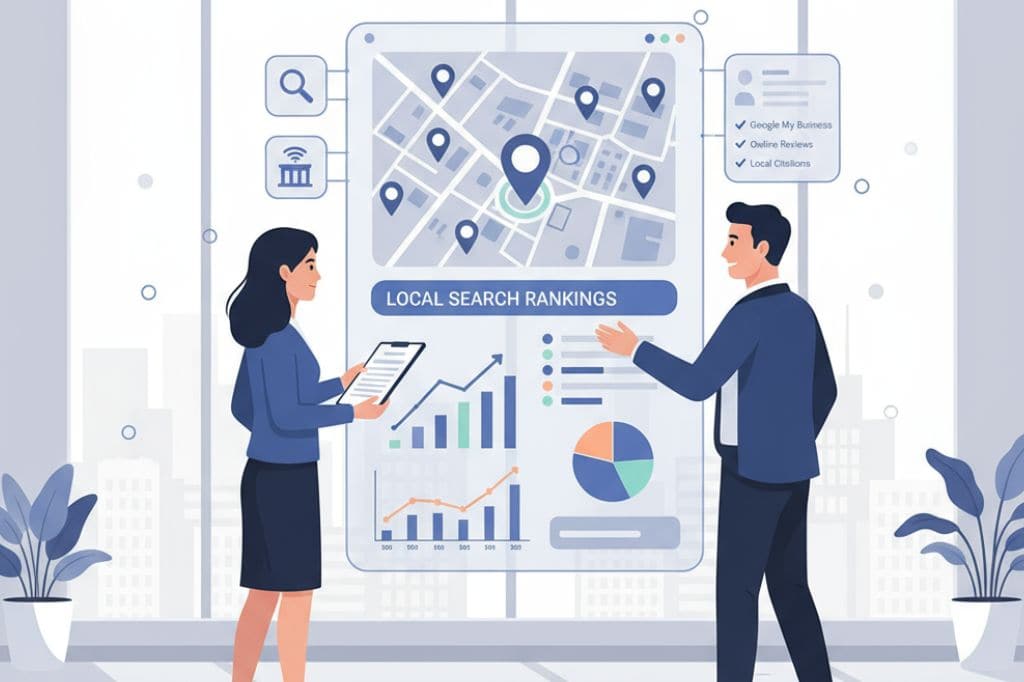
Local SEO aligns your site and profiles to what people in your area search, so you turn discovery into visits and sales.
Local visibility drives real action. Google reports 76% of people who search nearby visit a business within a day.
In this post, you learn a practical SEO strategy, pitfalls to avoid, and how to track results.
What Is a Local SEO Strategy
A local SEO strategy is your plan to rank for location-based queries on Google and other engines. You optimize your Google Business Profile, your website, and your citations so engines and users instantly understand who you are, where you are, and what you offer.
Start with intent. About 46% of Google queries carry local intent, so you target \”near me\”, city, and neighborhood terms. Map each keyword to a specific page, keep your name, address, and phone (NAP) consistent across the web, and add LocalBusiness schema so engines read your categories, hours, and reviews. Also keep your site fast and crawlable.
Helpful resources: Google Business Profile Help and SEO Starter Guide.
How Does a Strong Local Presence Shape Trust
Trust grows when your information is complete, consistent, and visible wherever people look. You validate credibility with accurate listings, fresh photos, and timely responses.
Studies show 88% of consumers trust online reviews as much as personal recommendations. You add high-quality images, products, and services to your profile, encourage ethical reviews, and respond within 24–48 hours. On your site, you feature testimonials, local case studies, and prominent contact details to reduce bounce and increase calls.
Tip: Use internal link blocks to guide readers from blog posts to service pages, and add a short on-page FAQ to earn rich results.
How Does Local SEO Improve Search Visibility and Results
Visibility improves when you cover on-page, off-page, and technical basics in a focused way. You make pages easy to crawl, render, and index—and make it effortless for users to act.
- On-page: Optimize titles, H1s, and H2s with city + service terms and write concise, helpful content that answers intent.
- Off-page: Earn links and citations from chambers, news sites, and niche directories.
- Technical: Pass Core Web Vitals; pages that load under 2.5s typically see stronger engagement.
Example: Position one often earns ~27% CTR, so small ranking lifts can deliver meaningful traffic. You add alt text, compress images, and use descriptive URLs like /city/service. Use Search Console’s URL Inspection to render pages as users do.
How Does Local SEO Drive Growth and ROI
Local SEO converts because you reach nearby searchers at intent-rich moments. You reduce wasted spend and turn rankings into revenue.
Google reports 28% of local searches lead to a purchase. You link discovery to action with click-to-call, directions, and short quote forms. Measure calls, forms, and store visits in GA4, tag profile links with UTM parameters, and attribute revenue to organic. Many businesses lower ad reliance as rankings compound.
By launching four neighborhood pages with unique photos and FAQs, one HVAC company reported a 35% lift in organic leads in 60 days.
What Mistakes Derail Your Local SEO Strategy
Regular audits prevent small issues from compounding. You fix duplication, thin content, and slow mobile performance before they harm visibility.
- Inconsistent NAP: You confuse engines when listings differ; standardize across top directories.
- Thin or duplicate pages: You consolidate similar pages, write unique values, and use canonical tags as needed.
- Slow speed: A 5s load can raise bounce probability by 90%+ versus 1s; compress, lazy-load, and use a CDN.
- Weak internal links: Orphan key pages; add contextual anchors from blogs to services.
- Poor mobile UX: You bury CTAs; place phone and directions buttons above the fold.
If a page should not appear, you apply noindex correctly and manage robots and sitemaps carefully. Avoid intrusive interstitials and keep ads balanced so users focus on content.
What Action Steps Should You Take Right Now
Quick wins compound when you align tasks to goals. Build a short roadmap and execute weekly.
- Claim and optimize Google Business Profile: Pick accurate categories, add hours, services, and products, upload photos, and place a tracked site link. Post weekly updates.
- Research location keywords: Map \”service + city\” and \”near me\” phrases to pages. Use Search Console and Maps insights to see real queries.
- Create or improve service and location pages: Add unique copy, local photos, and FAQs. Aim for 600–900 words and include schema. Link from relevant blogs.
- Build citations and quality links: Submit to core aggregators and niche sites. Even 5–10 strong local links can move rankings.
- Fix technical SEO: Pass Core Web Vitals, enable HTTPS, generate XML sitemaps, ensure indexability, and repair broken links.
- Track outcomes, not vanity metrics: Set GA4 conversions, connect Search Console, and review rankings, calls, and revenue monthly.
For AI and answer-engine results, you lead pages with concise answers, add step lists, and mark up FAQs. You also monitor Google Search updates and adapt fast.
FAQs
How fast can you improve your Google Business Profile?
Update photos, categories, and descriptions today; many edits reflect in minutes. Reviews and new Q&A can boost visibility within 2–4 weeks.
How long until you see local results?
You typically see movement in 4–8 weeks, with gains compounding over 3–6 months as links and reviews grow.
Do backlinks still matter for local SEO?
Yes. You prioritize relevant local news, sponsorships, and partner links over volume because quality correlates with rankings.
How do you use AI for local SEO content?
Draft outlines with tools, then add expert facts, unique photos, and local data. Always edit to match search intent.
Should you create separate pages for each location?
Yes, when locations serve different areas. Keep unique content and NAP on each page to avoid duplication.
What tools help you track progress?
Use GA4, Search Console, a rank tracker, and call tracking. Also review profile insights for real actions.
Key Takeaways
- Win local search by aligning your SEO strategy with intent, fast pages, and accurate profiles.
- Earn trust with consistent NAP, reviews, and helpful content that answers questions.
- Drive ROI by linking rankings to calls, visits, and revenue and iterating monthly.
- Stay current by following Search Central and tuning mobile UX and Core Web Vitals.
Local customers are searching—make sure they find you. Work with Strategic Websites to strengthen your Google Business Profile, improve your rankings, and convert more nearby searches into sales. Start building a high-performing local SEO strategy that compounds month after month.